
Call Us Today
+86-13161061539
Send us
- All
- Product Name
- Product Keyword
- Product Model
- Product Summary
- Product Description
- Multi Field Search
Views: 0 Author: Site Editor Publish Time: 2026-08-31 Origin: Site


Rising logistical costs and frequent transport failures constantly disrupt cold-chain networks for molecular diagnostics. Shipping wet assays across the globe introduces enormous vulnerabilities. Minor temperature excursions can ruin perfectly viable batches overnight. To solve this, assay developers are shifting rapidly toward ambient-temperature stability. They achieve this critical resilience through targeted dehydration techniques.
Transitioning to these stable formats requires precise alignment of formulation chemistry, strictly controlled thermal processes, and correctly specified equipment. You must ensure assay viability and regulatory compliance at every step. Producing a reliable freeze dried reagent demands both scientific rigor and robust hardware. This guide walks you through the scientific mechanics, hardware selection criteria, and scalability challenges. You will learn how to protect sensitive chemical mixtures while drastically reducing your operational dependency on refrigerated transport. We explore exactly how to balance upfront design choices against long-term operational success.
Financial & Operational Impact: Transitioning to freeze-dried formats drastically reduces cold-chain reliance, extending shelf life from weeks (refrigerated) to years (ambient).
Process Criticality: Successful reagent lyophilization relies on precise control of freezing (glass transition), primary drying (sublimation), and secondary drying (desorption).
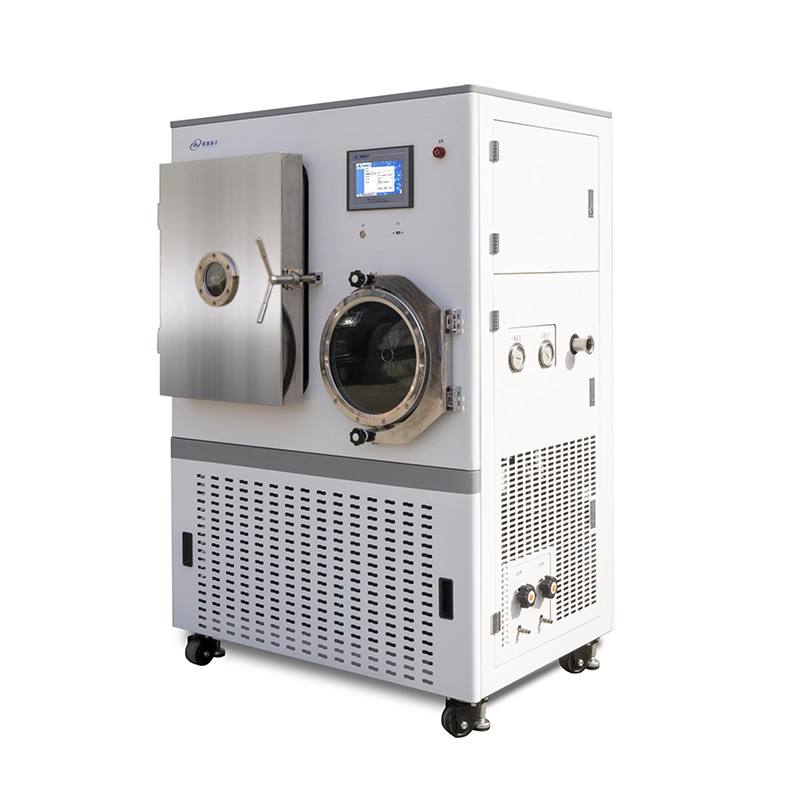
Equipment Selection: Choosing the right laboratory freeze dryer or commercial lyophilizer demands evaluating condenser capacity, shelf temperature uniformity, and vacuum control capabilities.
Implementation Reality: Formulation optimization (using cryoprotectants/lyoprotectants) is mandatory; not all biological samples can be lyophilized without altering structural integrity.
Quantifying the hidden costs of wet reagents reveals severe operational inefficiencies. Cold-chain logistics demand expensive dry-ice shipping, specialized warehousing, and continuous temperature monitoring. Product loss remains a constant threat. A simple delay at customs can compromise an entire shipment. By eliminating moisture, companies bypass these vulnerabilities entirely.
You must define clear success criteria before beginning the dehydration transition. A successful conversion maintains at least 95% enzymatic activity post-reconstitution. The final cake must dissolve rapidly and completely. Furthermore, achieving less than 2% residual moisture is usually necessary to guarantee true ambient stability. Hitting these metrics ensures the product performs identically to its wet counterpart.
Balancing capital expenditure against operational savings requires careful analysis. Purchasing a commercial-grade unit involves significant upfront investment. However, you quickly recoup this cost through logistics savings. Eliminating styrofoam coolers and expedited shipping fees creates immediate margin improvements. Furthermore, ambient products unlock new geographical markets previously unreachable by cold-chain logistics.
Operational Factor | Traditional Wet Reagents | Ambient (Freeze-Dried) Reagents |
|---|---|---|
Shipping Logistics | Requires dry ice and expedited transport. | Standard ground or air shipping safely suffices. |
Storage Infrastructure | Demands costly -20°C or -80°C freezers. | Standard room temperature shelving works perfectly. |
Shelf Life | Typically measured in weeks or months. | Frequently extends to two years or longer. |
Risk of Spoilage | High vulnerability to power outages and delays. | Practically immune to standard temperature fluctuations. |
Understanding the fundamental science guarantees better equipment operation. The procedure occurs in three distinct thermodynamic phases. Each phase requires exact manipulation of temperature and pressure.
Phase 1: Freezing (Thermal Treatment)
Controlled cooling establishes the physical structure of the product. You must lower the temperature past the glass transition temperature ($T_g$). This step solidifies the matrix without causing massive ice-crystal damage. Fast cooling creates small crystals, which look elegant but restrict vapor flow later. Slow cooling grows larger crystals, creating wider channels for vapor escape. You must carefully balance this cooling rate to protect sensitive biological samples from sheer stress while maintaining an efficient structure.
Phase 2: Primary Drying (Sublimation)
This phase removes the vast majority of ice. The system lowers the chamber pressure to create a deep vacuum. Simultaneously, the equipment applies gentle shelf heat. This combination causes the solid ice to sublimate directly into vapor. The vapor travels to the cold condenser trap. You face a major risk here called "melt-back." If shelf temperatures push the product above its critical collapse temperature ($T_c$), the structural cake melts and collapses. A collapsed cake ruins both the visual elegance and the functional viability of the assay.
Phase 3: Secondary Drying (Desorption)
Even after all visible ice disappears, bound water molecules remain attached to the protein structures. Secondary drying strips away this microscopic moisture. The system increases the shelf temperature further while maintaining maximum vacuum. This forces the bound water to desorb from the matrix. You must define target residual moisture limits early in development. Dropping moisture below 1% might overly desiccate and destroy some proteins. Leaving moisture above 3% might cause premature degradation during room-temperature storage.
Hardware capabilities directly dictate the quality of your finished chemistry. Equipment spans three distinct solution categories. R&D benchtop units feature minimal controls and handle small exploratory batches. Pilot-scale systems offer sophisticated programming identical to production units but maintain a smaller footprint. Production-scale units process tens of thousands of vials simultaneously.
Mapping specific hardware features to your desired scientific outcomes prevents costly purchasing mistakes. Pay close attention to condenser capabilities. You must match trap temperatures to your specific solvent types. Aqueous solutions freeze well around -50°C. However, organic solvents require much colder traps, typically reaching -85°C to -105°C to prevent pump contamination.
Thermal uniformity across the shelves dictates batch-to-batch consistency. Precision matters deeply. High-end systems circulate temperature-controlled silicone oil through internal shelf channels. This circulation ensures every vial experiences the exact same thermal environment. Units lacking fluid-filled shelves often produce inconsistent moisture levels across the same batch.
Vacuum control requires equal scrutiny. Advanced systems utilize capacitance manometers. These sensors measure absolute pressure regardless of the gas composition inside the chamber. Proportional valves use this data to introduce microscopic bleeds of inert gas. This precise pressure control helps optimize the sublimation rate and accelerates primary drying safely.
Calculate peak capacity requirements before speaking to vendors.
Measure available laboratory footprint and check facility power ratings.
Determine if you require clean-in-place (CIP) or sterilize-in-place (SIP) functionality.
Verify that the laboratory freeze dryer supports future scalability.
Assess the software interface for automated cycle programming and data export.
Hardware alone cannot rescue a poorly designed chemical matrix. Formulation realities often surprise new developers. The active pharmaceutical ingredient or diagnostic enzyme rarely survives dehydration on its own. You must employ protective excipients. Bulking agents like mannitol create a robust, elegant cake structure. Cryoprotectants and lyoprotectants, such as trehalose or sucrose, replace water molecules during dehydration. They lock the complex proteins into a stable, glassy state. Without these additives, the functional molecules unravel and degrade.
Successful reagent lyophilization requires constant cycle optimization. Many operators fall into common vulnerability traps. Overly conservative cycles run far too slowly. They apply minimal heat and drag primary drying out for days, wasting immense amounts of facility energy. Conversely, aggressive cycles push temperatures too high too fast. This aggressive approach melts the product and compromises assay efficacy entirely. You must find the precise thermal boundary and operate safely just below it.
Relying on guesswork guarantees failure. We strongly recommend utilizing process analytical technologies (PAT) during cycle development. Wireless temperature probes placed directly inside sample vials map the actual product temperature in real-time. Pirani gauges help identify the exact moment primary drying concludes. Tunable Diode Laser Absorption Spectroscopy (TDLAS) measures the actual water vapor mass flow leaving the chamber. By leveraging these technologies, you validate assumptions scientifically rather than relying on visual observation alone.
Transitioning from an R&D laboratory to a full production floor introduces nonlinear thermal challenges. A thermal profile perfected in a small benchtop unit will behave differently in a massive pilot plant. Edge effects become prominent. Vials sitting on the perimeter of a large shelf absorb radiant heat from the chamber walls. They dry significantly faster than vials located in the center of the shelf array. You must make significant thermal dynamic adjustments when scaling up. Engineers often install shielding or adjust shelf temperatures to mitigate these variations.
Regulated pharmaceutical and diagnostic manufacturing requires strict adherence to compliance lenses. Regulatory bodies like the FDA demand absolute traceability. When specifying a commercial lyophilizer, you must ensure the software meets 21 CFR Part 11 requirements. The system must support encrypted data logging, comprehensive software validation, and unalterable audit trails. An inspector must be able to verify exactly who ran a specific cycle, what parameters changed, and how the machine performed at every minute of the batch.
Your next steps require deliberate planning. Audit your current and projected throughput needs accurately. Do not buy capacity for ten years in the future if it compromises your footprint today. Consult directly with equipment engineers. Request a proof-of-concept run using your specific formulation before committing to any large-scale hardware. Testing your actual chemistry in their pilot facility reveals unknown bottlenecks early.
Producing a stable, ambient-temperature product represents a highly delicate synergy between formulation chemistry and precision thermal engineering. Excelling in one area cannot compensate for failures in the other. You must protect the molecular structure using intelligent excipients while simultaneously applying exact thermodynamic forces to remove moisture safely.
Lab managers and assay developers should calculate their current cold-chain shipping deficits immediately. Compare those ongoing, compounding losses against the projected return on investment of an optimized dehydration workflow. Taking action now secures your supply chain, expands your global distribution capabilities, and ultimately protects the critical integrity of your diagnostic products.
A: No. Many complex proteins, delicate cellular structures, and specific viral vectors degrade under deep vacuum and freezing stresses. You must conduct comprehensive pilot testing. Using targeted excipient formulations, such as specific sugars or polymers, often helps protect these structures, but some compounds remain fundamentally unsuited for dehydration.
A: Cycles vary drastically and generally range from 24 to 72 hours or more. The exact duration depends heavily on the initial fill volume, the total cake thickness, the complexity of the chemical matrix, and the condenser efficiency of the equipment being used.
A: Benchtop units typically use simple manifold attachments or basic unheated shelves for exploratory drying. Pilot systems feature internal fluid-circulating stoppering shelves, advanced vacuum controls, and data logging. Pilot units accurately mimic production environments, allowing you to transfer cycle recipes directly to commercial manufacturing scales.