
Call Us Today
+86-13161061539
Send us
- All
- Product Name
- Product Keyword
- Product Model
- Product Summary
- Product Description
- Multi Field Search
Views: 0 Author: Site Editor Publish Time: 2026-10-26 Origin: Site


Scaling the production of complex GLP-1/GIP receptor agonists like tirzepatide presents strict structural and stability challenges. Standard bioprocessing lines simply cannot accommodate these unique demands. You will find a 39-amino acid backbone in this highly complex molecule. It also includes a specifically modified C20 fatty diacid moiety attached via a delicate linker. Transitioning from small clinical batches to massive commercial-scale production requires rigorous oversight. You must carefully control both synthesis methodologies and downstream stabilization. Manufacturers face intense pressure to deliver pure, stable products every single time. For CDMOs and pharmaceutical manufacturers, optimizing the tirzepatide manufacturing process means evaluating the cost-to-yield ratio of hybrid synthesis. It also requires mitigating severe batch-loss risks. You accomplish this through advanced, compliant lyophilization technology. This article explores how to bridge the gap between initial peptide assembly and final product preservation.
Synthesis Scalability: A hybrid approach combining Solid-Phase Peptide Synthesis (SPPS) and Liquid-Phase Peptide Synthesis (LPPS) via fragment condensation is essential for maintaining purity at commercial volumes.
Downstream Bottlenecks: Purification (prep-HPLC) and solvent removal dictate throughput, making scalable downstream infrastructure critical to ROI.
Stabilization Imperative: Tirzepatide’s molecular complexity mandates the use of a high-spec biopharmaceutical freeze dryer to ensure shelf-life and API stability.
Equipment Evaluation: Procuring a GMP freeze dryer requires prioritizing shelf-temperature uniformity, auto-loading capabilities, and Process Analytical Technology (PAT) integration to meet stringent EU GMP Annex 1 guidelines.
The molecular challenge of tirzepatide begins at its core structure. It features 39 amino acids. Two Aib (alpha-aminoisobutyric acid) residues protect the peptide from enzymatic degradation. However, these same residues create significant steric hindrance during synthesis. Furthermore, a fatty acid side chain attaches via a linker at Lys20. This specific modification extends half-life but drastically complicates the assembly process.
Defining the business problem requires examining financial exposure. Manufacturers face extremely high raw material costs. Multi-step syntheses often suffer incremental yield drops. Even minor yield losses or impurity spikes exponentially increase the cost of goods sold (COGS). Unpredictable reactions frequently force operators to discard entire high-value batches.
A commercially viable tirzepatide manufacturing process must achieve predictable outcomes. We look for three primary success criteria during scale-up:
Predictable impurity profiles across every single production run.
Scalable solvent recovery systems capable of handling massive liquid volumes.
Verifiable batch-to-batch consistency to satisfy stringent regulatory reviews.
Evaluating synthesis approaches requires looking closely at commercial scalability. Linear SPPS (Solid-Phase Peptide Synthesis) builds molecules sequentially. For a 39-amino-acid chain, linear synthesis poses a high risk of truncated sequences. Overall yield drops significantly at commercial volumes. Errors accumulate exponentially after adding 20 amino acids.
The hybrid strategy resolves many of these issues. This method combines SPPS and Liquid-Phase Peptide Synthesis (LPPS). You synthesize shorter peptide fragments on solid resin first. Next, you cleave these fragments. Finally, you couple the purified fragments in a liquid phase. Fragment condensation reduces the accumulation of closely related impurities. It physically prevents long, incorrect sequences from forming.
Implementation realities dictate strict chemical controls. You must utilize highly optimized coupling reagents. You also need strict racemization control during the liquid-phase joining steps. Mismanaged coupling leads to isomeric impurities.
Purification relies heavily on preparative HPLC (High-Performance Liquid Chromatography). You must carefully evaluate column scale. Solvent consumption becomes a major logistical hurdle. Transitioning the liquid eluate to a stable powder dictates your final throughput capacity.
Synthesis Methodology Comparison
Synthesis Method | Truncation Risk | Purity at Commercial Scale | Solvent Consumption |
|---|---|---|---|
Linear SPPS | High | Low to Moderate | Extremely High |
Hybrid (SPPS + LPPS) | Low | High (Easier HPLC separation) | Moderate (Optimized) |
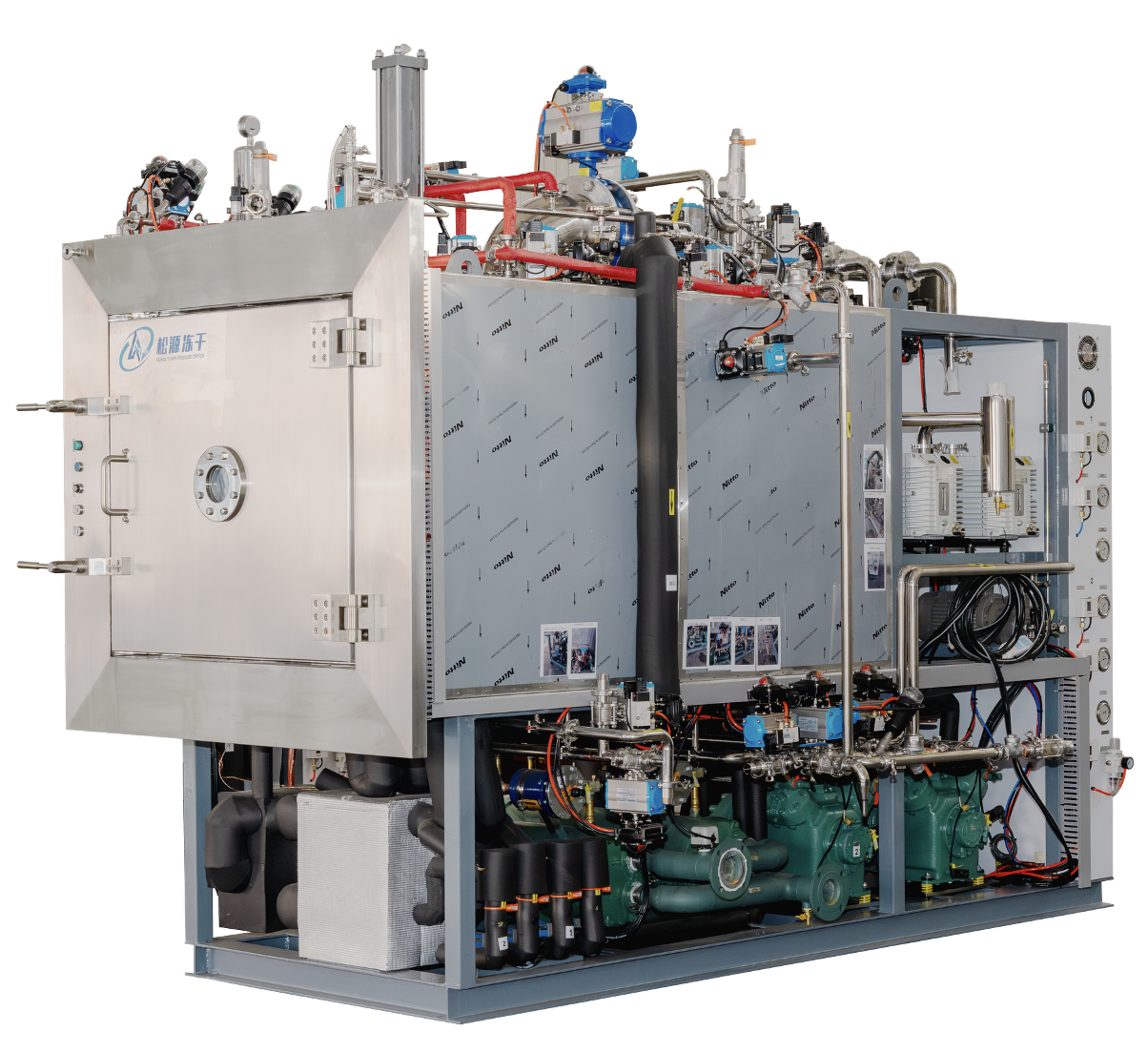
The stability mandate for complex molecules is absolute. Liquid storage of complex modified peptides leads to rapid degradation. We routinely observe deamidation, aggregation, or hydrolysis in aqueous states. Moisture acts as a potent catalyst for these destructive chemical pathways.
Transitioning to powder represents a critical manufacturing step. Removing moisture without thermal degradation requires highly specialized equipment. You need a top-tier biopharmaceutical freeze dryer to handle these delicate molecular structures. Conventional drying methods apply excess heat and destroy the active pharmaceutical ingredient (API).
Process considerations demand thermodynamic precision. You must establish the exact glass transition temperature (Tg') of your specific formulation matrix. You also need to determine the collapse temperature (Tc). Tirzepatide formulations contain unique excipients and buffers. These additions often depress the critical freezing temperatures.
Risk mitigation happens primarily during the primary drying phase. Precise thermal control prevents meltback. Meltback destroys the porous cake structure. A flawless, porous cake ensures rapid reconstitution in the final clinical setting. Practitioners rely entirely on this immediate solubility.
Selecting lyophilization infrastructure requires a rigid analytical framework. You must evaluate multiple technical dimensions before shortlisting vendors. A standard dryer will not suffice for peptide production.
Thermodynamic Performance: Sublimation requires exact energy inputs. You need precise shelf temperature uniformity (e.g., ±1°C). This ensures consistent sublimation rates across the entire batch. Uneven heating causes localized product collapse.
Condenser Capacity: Peptide formulations require massive solvent volumes. You must size the condenser appropriately. Proper sizing prevents choke flow during peak sublimation. Choke flow stalls the entire vapor transfer process.
Process Analytical Technology (PAT): Move away from empirical guessing. Integrate tunable diode laser absorption spectroscopy (TDLAS). You can also utilize wireless temperature sensors. These advanced tools monitor batch moisture in real time.
Deploying a commercial pharmaceutical lyophilizer requires matching pilot-scale data to production configurations. Scalability outcomes depend on identical geometry and vapor flow dynamics. This precise alignment minimizes technology transfer risks. It guarantees your commercial batches mirror your clinical successes.
Regulatory alignment dictates major engineering choices. Your equipment must meet FDA 21 CFR Part 11 requirements. Electronic records and data integrity are entirely non-negotiable. Auditors scrutinize electronic audit trails constantly during facility inspections.
Annex 1 compliance changes how we operate cleanrooms. The European Union mandates minimized human intervention. Contamination Control Strategies (CCS) dominate modern facility design. Automated loading and unloading systems (ALUS) are becoming mandatory. You cannot process highly potent or high-value batches manually anymore. Integrating a compliant GMP freeze dryer ensures you meet these strict barrier technology requirements.
Sterilization and cleaning require thorough upfront evaluation. You must review Clean-in-Place (CIP) and Sterilize-in-Place (SIP) capabilities carefully. Maintain transparent assumptions regarding cycle downtime. Utility requirements often exceed initial engineering estimates.
Validation timelines often hide massive schedule delays. Factory Acceptance Testing (FAT) takes weeks to complete. Site Acceptance Testing (SAT) requires intense site coordination. Installation and Operational Qualification (IQ/OQ) demand rigorous documentation. Plan these phases meticulously to avoid delayed market entry.
Commercializing tirzepatide demands a seamless engineering bridge. You must connect high-yield hybrid synthesis to flawless downstream lyophilization. Success relies entirely on eliminating thermal and chemical bottlenecks early.
Decision-makers must prioritize demonstrable technical experience. When evaluating equipment or CDMO partners, look for proven hybrid fragment coupling expertise. Examine the precise technical specs of their lyophilization fleet carefully. Avoid vendors lacking Annex 1 compliance experience.
Take immediate action on your production lines. Audit your current downstream capacities today. Define specific PAT requirements for your unique peptide formulation. Finally, request detailed thermal mapping data from potential equipment vendors before signing procurement contracts.
A: Because tirzepatide is a long (39-AA) and heavily modified peptide, linear synthesis often results in unacceptable levels of deletion impurities. Fragment condensation improves overall yield and simplifies HPLC purification.
A: Cycle times vary heavily based on excipients and fill volume, but industrial peptide cycles often range from 72 to 120+ hours. Advanced PAT tools can help optimize and shorten these cycles safely.
A: The latest Annex 1 revisions heavily emphasize Contamination Control Strategies (CCS), making barrier technologies (isolators/RABS) and automated loading systems critical criteria when selecting a new GMP freeze dryer.