
Call Us Today
+86-13161061539
Send us
- All
- Product Name
- Product Keyword
- Product Model
- Product Summary
- Product Description
- Multi Field Search
Views: 0 Author: Site Editor Publish Time: 2026-08-10 Origin: Site


Lyophilization remains one of the most reliable methods for preserving sensitive pharmaceuticals. Yet, navigating the primary drying phase often feels like walking a strict tightrope. You must balance delicate product stability against aggressive cycle efficiency. This balancing act defines the success of your entire manufacturing operation.
Misaligning your thermal parameters carries severe business consequences. Rejected batches, compromised active pharmaceutical ingredients (APIs), and unnecessarily long drying cycles quickly bottleneck facility production. Formulators simply cannot afford to guess when establishing these operational thresholds.
This article clarifies the vital distinctions between Eutectic Temperature (Teu), Glass Transition (Tg'), and Collapse Temperature (Tc). We will explore how to identify the true ceiling for your specific formulation. Furthermore, you will learn how to evaluate precision equipment designed to control these variables. Accurate measurement prevents catastrophic failures during critical scale-up phases.
Formulation determines the limit: Crystalline matrices rely on Eutectic Temperature (Teu), while amorphous systems (like most proteins and biologics) are limited by Glass Transition (Tg') and Collapse Temperature (Tc).
Optimization requires balance: Operating too far below the critical temperature unnecessarily extends cycle times; operating too close risks cake collapse and batch loss.
Equipment capability is a bottleneck: Transitioning from empirical guesswork to data-driven cycle design requires a Freeze Dryer with Eutectic Point Testing and precise shelf temperature control.
Scalability dictates R&D purchasing: Evaluating an R&D Freeze Dryer must include its ability to mimic the heat transfer coefficients (Kv) of production-scale units.
Formulators frequently use thermal terminology interchangeably in the lab. This semantic confusion directly leads to flawed primary drying parameters. Understanding the precise definition of each thermal threshold ensures you protect your product effectively. You build a robust cycle only when you know exactly what boundary you are testing against.
Amorphous systems freeze into a rigid, disordered glass. The Glass Transition Temperature (Tg') marks the specific, reversible transition where this freeze-concentrate softens. It changes from a rigid glass into a viscous rubber. We consider Tg' the absolute minimum baseline for structural mobility. Below this point, the product remains safe. Above it, molecular mobility begins, increasing the risk of structural shift.
Collapse Temperature (Tc) represents a practical, visually observable failure point. It typically sits 1°C to 3°C higher than Tg' in amorphous products. At this specific temperature, the interstitial matrix loses its structural integrity entirely. The cake undergoes macroscopic collapse. The pore structure seals shut, trapping moisture inside.
Crystalline systems behave quite differently under freezing conditions. Eutectic Temperature (Teu) defines the exact point where the solute and solvent melt simultaneously. We call this complete phase change meltback. It is a catastrophic event for the drying cake, turning the solid matrix back into a liquid state instantly.
You must pinpoint which of these three values acts as your formulation's true ceiling. We refer to this ultimate boundary as the Critical Temperature in Lyophilization. Your product temperature (Tp) must stay safely below this specific limit during the entire primary drying stage to guarantee cake elegance and stability.
We group formulations by their fundamental structural behavior. This structural categorization directly dictates your process success criteria. You cannot design a universal drying cycle because molecules crystallize or vitrify distinctly.
Salts and simple excipients like mannitol present a straightforward thermal challenge. They crystallize neatly during the initial freezing phase. The process limit here is strictly the Eutectic Temperature (Teu). If you exceed Teu during primary drying, you trigger catastrophic meltback. The product turns into a useless liquid pool inside the vial. Cycle design for crystalline systems focuses entirely on avoiding this sharp melting point.
Proteins, complex APIs, and delicate peptides introduce significant thermodynamic complexity. They do not form rigid crystalline lattices. Therefore, they completely lack a true eutectic melting point. Cycle design for these delicate molecules must rely heavily on tracking Tg' and Tc. You must carefully manage the transition into the viscous rubber state to prevent the micro-collapse of the protein structure.
Real-world pharmaceutical formulations rarely fit cleanly into one distinct category. Multi-component mixtures often exhibit both eutectic melting and distinct glass transitions simultaneously. Bulking agents might crystallize rapidly, while the active API remains entirely amorphous. These highly complex systems require advanced thermal characterization before any freezing begins.
Simple salts and sugars: Exhibit purely crystalline behavior and rely strictly on Teu limits.
Monoclonal antibodies: Exhibit purely amorphous behavior and rely exclusively on Tg' and Tc limits.
Vaccine adjuvants mixed alongside stabilizers: Exhibit mixed behavior requiring comprehensive thermal screening.
Evaluating process outcomes means calculating the exact cost of getting your cycle wrong. Thermal characterization acts as your primary financial safeguard. It prevents costly manufacturing errors and keeps your production schedule on track.
Vapor pressure shares an exponential relationship with product temperature. Dropping your shelf temperature just 1°C below the necessary safety margin adds hours or even days to a drying cycle. This highly cautious approach drastically inflates facility energy consumption. It directly throttles your overall manufacturing throughput. You tie up expensive equipment for unnecessary durations, reducing your total batch yield per quarter.
Conversely, pushing temperatures too high invites immediate structural disaster. You risk inducing both macro-collapse and micro-collapse within the vial. These structural failures trap residual moisture deep inside the drying cake. Reconstitution times skyrocket when clinicians attempt to use the product. API efficacy degrades rapidly due to the elevated moisture levels. Ultimately, aggressive heating without proper boundaries leads to complete batch rejection by quality control teams.
Conservative cycles offer a safe, reliable harbor during early clinical phases. We clearly understand why formulators lean on them initially to secure clinical trial material. However, they prove completely unviable financially for commercial scale-out. You must transition to optimized, data-driven parameters as you approach commercialization.
Cycle Strategy | Thermal Approach | Business Impact | Quality Risk |
|---|---|---|---|
Conservative | Targeting well below critical limits | High energy usage, low throughput | Low risk of collapse, safe but slow |
Aggressive | Flirting closely with critical limits | Faster processing, maximized throughput | High risk of batch rejection and API degradation |
Optimized | Data-driven approach using precise PAT | Balanced throughput and energy efficiency | Consistent quality, controlled moisture levels |
Standard benchtop freeze dryers lack the sophisticated controls needed for serious cycle development. You simply cannot troubleshoot complex protein formulations using basic manifold systems. Modern optimization demands industrial-grade precision in the laboratory.
Modern process optimization demands programmable, fluid-cooled shelves. You need equipment capable of holding shelf temperatures strictly within ±1°C. This extreme precision allows you to safely flirt with the formulation collapse margin. You maximize sublimation rates without destroying the cake. Inferior compressor systems create temperature swings, which silently ruin delicate amorphous structures.
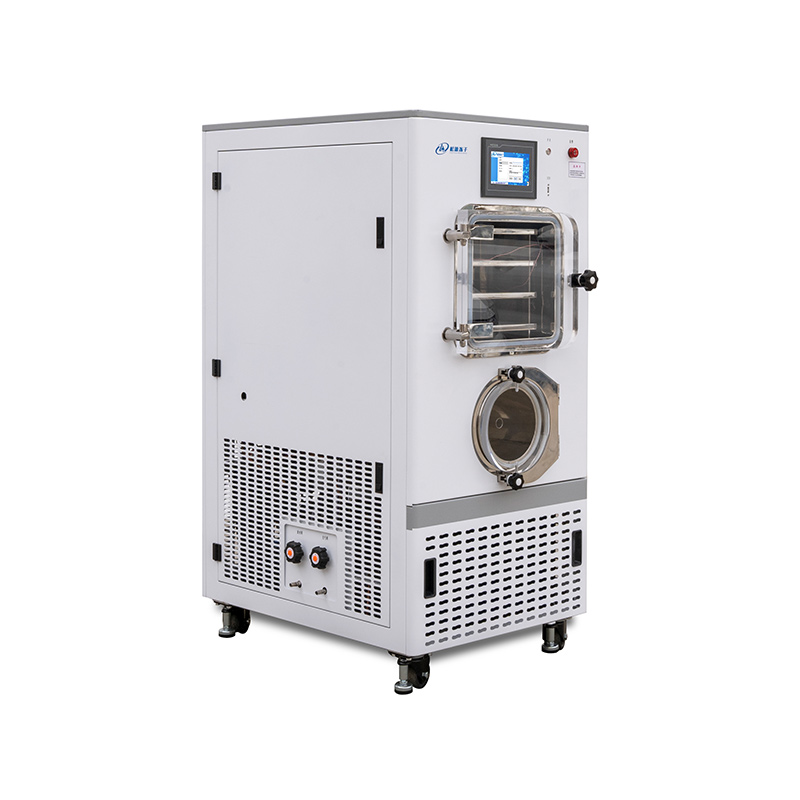
Transitioning away from empirical guesswork requires specialized internal sensors. Utilizing a Freeze Dryer with Eutectic Point Testing transforms your entire development workflow. Resistivity and impedance measurements pinpoint invisible phase changes perfectly. Integrated thermal analysis tools, such as Tunable Diode Laser Absorption Spectroscopy (TDLAS), capture real-time Tp versus Tc data continuously. They give you a window into the exact physical state of the vial.
Aggressive cycle optimization generates massive vapor volumes rapidly. You push the cycle extremely close to its thermal limit to save time. Your hardware must handle this rapid vapor flow efficiently. If the internal condenser chokes, chamber pressure spikes uncontrollably. The batch then collapses due to the sudden loss of sublimation cooling. Evaluating an R&D Freeze Dryer means ensuring its condenser capacity perfectly matches its rapid shelf heating capabilities.
We recommend verifying these specific analytical capabilities before purchasing laboratory equipment:
Silicone oil-circulated shelves ensuring uniform thermal distribution across all plates.
Direct integration of electrical impedance probes for real-time phase change monitoring.
Capacitance manometers paired alongside Pirani gauges for accurate comparative pressure tracking.
Condenser trapping speeds exceeding the maximum theoretical sublimation rate of the product.
Defining precise thermal parameters in the laboratory represents only half the battle. You must ensure these exact parameters translate accurately to large manufacturing floors. Scale-up introduces entirely new thermodynamic variables.
Heat transfer mechanisms shift dramatically between different equipment scales. A small lab unit relies on radiation and conduction quite differently compared to a massive production system. Acrylic doors on small chambers create severe edge effects. These effects skew your drying data significantly. Shelf surface emissivity variations alter local drying rates across the chamber. You must account for these mechanical differences early in development.
Validating your thermal ceiling at the pilot scale demands robust Process Analytical Technology (PAT) tools. Comparative pressure measurement offers a highly reliable solution. Tracking the continuous variance between a Pirani gauge and a Capacitance Manometer helps operators determine the true end of primary drying. You achieve this crucial insight without ever compromising your established collapse margin. When the two pressure readings converge, the heavy vapor flow has ceased.
Vendor selection profoundly shapes your commercial scale-up success. Prioritize OEMs offering true linear scalability. You want identical shelf designs, matching inter-shelf distances, and unified control software. A well-designed Pilot Freeze Dryer mimics the exact heat transfer coefficients (Kv) of massive production equipment. This precise engineering alignment prevents nasty thermal surprises during final validation runs.
Knowing the fundamental difference between Tc, Teu, and Tg' merely sets your baseline foundation. The real commercial value lies in applying this exact thermal data to intelligently optimize your primary drying phases.
Investing heavily in appropriately instrumented lab-scale equipment heavily mitigates the risk of catastrophic failure during commercial manufacturing scale-up. You replace guesswork with concrete thermal evidence, ensuring rapid returns on investment.
We encourage you to audit your current cycle development protocols today. Request a thorough thermal characterization feasibility study for your most complex products. Finally, consult directly with an equipment engineer to evaluate fully instrumented pilot systems capable of precise data tracking.
A: Exceeding Tc causes the interstitial matrix to lose structural integrity. While it may not cause complete melting, the cake collapses into a dense structure. This macro-collapse traps water, drastically increasing residual moisture. Reconstitution becomes difficult, and you risk severe API degradation due to the trapped moisture and altered microenvironment.
A: Proteins and complex biologics typically do not crystallize during freezing. Instead, they form amorphous, disorganized structures known as glasses. Because they lack a crystalline lattice, they do not possess a true eutectic melting point. Cycle design for these formulations must instead rely on determining the Glass Transition (Tg') and Collapse Temperature (Tc).
A: These advanced units utilize specialized electrical resistance or impedance probes. Operators insert these probes directly into the product vial alongside traditional thermocouples. As the shelf temperature shifts, the probes measure changes in electrical conductivity. A sudden shift in resistance accurately detects real-time phase changes, identifying exactly when the solid matrix turns into a liquid or rubber.
A: Advanced R&D systems equipped with Process Analytical Technology provide excellent approximations and robust testing environments. However, they are rarely the starting point. Baseline thermal characterization usually requires standalone analytical instruments. You should conduct Freeze Drying Microscopy (FDM) or Differential Scanning Calorimetry (DSC) first to establish the absolute thermal limits before optimizing in the dryer.