
Call Us Today
+86-13161061539
Send us
- All
- Product Name
- Product Keyword
- Product Model
- Product Summary
- Product Description
- Multi Field Search
Views: 0 Author: Site Editor Publish Time: 2026-08-31 Origin: Site


The vacuum pump represents the most critical failure point in any freeze-drying setup. It dictates batch success and defines your daily workflow efficiency. If this component fails mid-cycle, you risk losing valuable product and hours of processing time.
Buyers often fixate on the upfront price of new hardware. They frequently underestimate the hidden operational expenses tied to daily maintenance routines. Consumable costs, labor hours, and potential downtime add up rapidly over a few short years. These ongoing financial burdens can easily eclipse the initial purchase savings.
This article provides an evidence-based framework for your decision stage. We will explore how to choose between oil-sealed and dry vacuum technologies. You will learn how to evaluate these options based on your application scale, budget constraints, and daily maintenance capacity. By understanding the mechanical differences, you can select a system tailored to your specific processing demands.
Maintenance is the primary differentiator: Oil-sealed pumps require frequent oil filtering and changes to prevent moisture damage; dry pumps eliminate daily maintenance but require scheduled rebuilds.
Total Cost of Ownership (TCO) flips over time: While oil-sealed units are cheaper upfront, the ongoing cost of premium vacuum oil and labor often makes dry pumps more economical within a 2- to 3-year window.
Application dictates the technology: A dedicated home freeze dryer setup may tolerate the noise and mess of an oil pump, but cleanrooms, continuous-use labs, and commercial food workflows increasingly mandate oil-free solutions to eliminate backstreaming and contamination risks.
A reliable Vacuum Pump for Freeze Dryer performs one core function. It drops the internal chamber pressure below the triple point of water. This precise physical state allows frozen ice to transition directly into vapor. The process skips the liquid phase entirely, a phenomenon known as sublimation.
To achieve successful sublimation, the system usually requires deep vacuums operating under 100 mTorr. Reaching this extreme low pressure demands robust engineering. It also requires a pump capable of sustained, high-stress operation over multiple days.
Freeze drying punishes vacuum hardware far more than standard laboratory degassing. Water vapor tolerance acts as the ultimate stress test. During a batch, the cold trap captures most of the moisture. However, some water vapor always bypasses the ice condenser. This rogue moisture travels directly into the pump mechanism.
When vapor enters an incompatible system, it condenses back into liquid water. This liquid mixes into internal components. Engineers combat this issue by integrating gas ballast valves. A gas ballast introduces a small amount of dry air into the compression cycle. This prevents the vapor from condensing before it exhausts from the system.
Evaluating reliability requires looking beyond basic performance specs. Consider the severe cost of mid-batch failure. If a pump seizes overnight, the pressure rises. The frozen product thaws and melts, ruining the entire batch. Lost product translates directly to lost revenue. Ruined time disrupts your production schedule. Therefore, hardware reliability stands as the primary metric for justifying your initial investment.
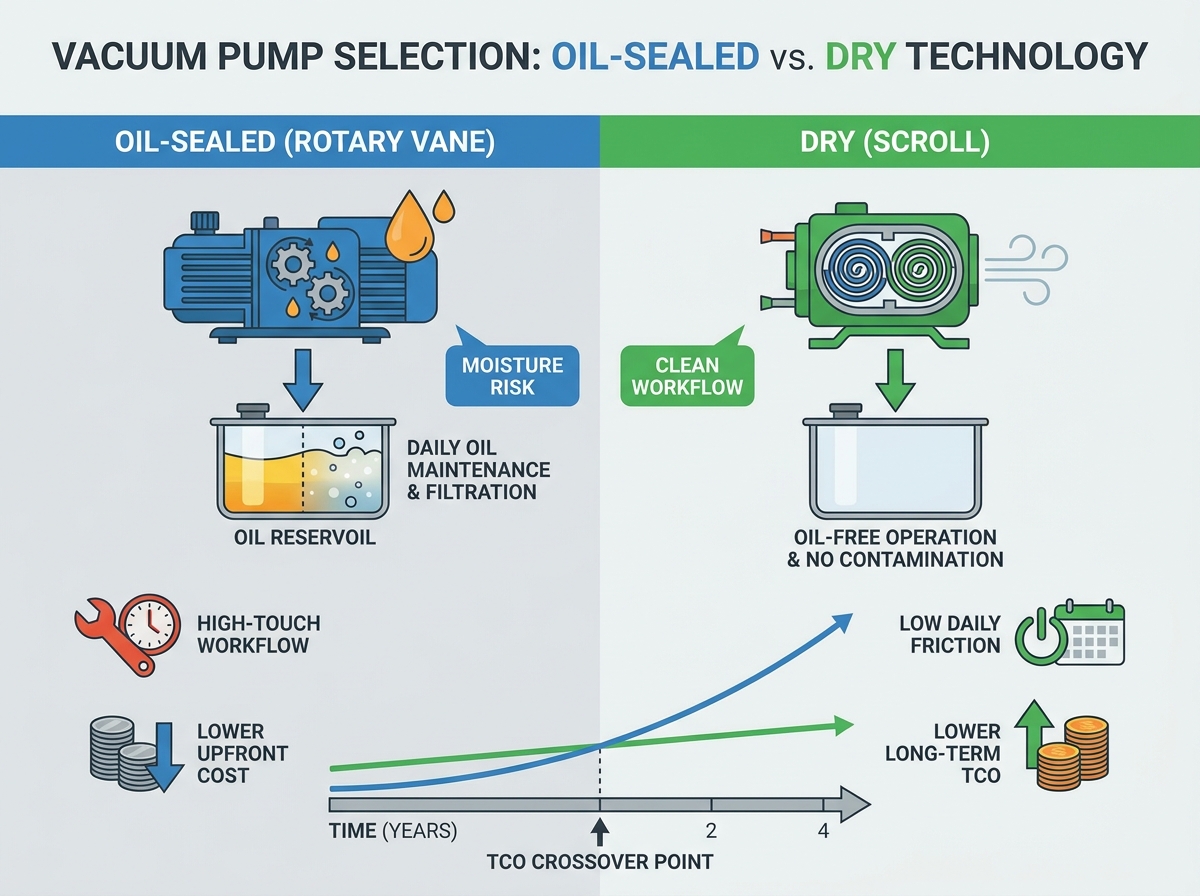
An Oil-Sealed Vacuum Pump represents the traditional standard for freeze drying. This technology relies heavily on specialized hydrocarbon fluids to function. The fluid lubricates moving metal parts and absorbs excess heat. Crucially, it creates the microscopic internal seal required to pull a deep vacuum.
The upfront financial advantage drives their popularity. Lower initial acquisition costs make these models highly accessible. They remain the default entry-level choice for small businesses and hobbyists. However, this lower price tag comes attached to rigid operational demands.
Users face significant implementation realities and friction points. A standard Rotary Vane Vacuum Pump requires aggressive, consistent maintenance to survive freeze-drying conditions. You cannot simply turn it on and walk away.
Visual Inspection: You must check the fluid after every single batch. You are looking for milky discoloration, which indicates a water emulsion.
Draining and Filtering: The physical workflow involves draining hot fluid into a container. You then filter out particulates and water before returning the fluid to the reservoir.
Frequent Replacements: When the fluid degrades completely, you must discard it. Refilling the unit requires purchasing premium-grade replacements regularly.
Risk assessment reveals a few specific hazards. These units can exhaust fine mist into your room. You must install demister exhaust filters to capture this aerosolized residue. Furthermore, power failures introduce a severe contamination risk. If the power drops unexpectedly, a phenomenon called backstreaming can occur. Internal pressure changes can suck fluid backward through the hoses, contaminating your expensive freeze dryer chamber.
An Oil-Free Scroll Vacuum Pump offers a fundamentally different mechanical approach. It eliminates fluids entirely from the vacuum path. The design features two interleaving spiral scrolls. One scroll remains stationary. The other orbits eccentrically within it. This motion traps pockets of gas at the outer edge, compressing them toward the center before exhausting them.
The operational outcomes radically alter daily workflows. You experience a complete elimination of daily draining routines. You no longer need to buy expensive demister filters. You completely remove the risk of hydrocarbon backstreaming into your clean processing chamber. The machine operates reliably without constant human intervention.
Sustainability and compliance drive many buyers toward this technology. Cleanrooms and medical laboratories often ban fluid-based systems outright. A dry setup aligns perfectly with stringent environmental criteria. You generate zero hazardous waste, eliminating complex disposal protocols.
We must provide transparent assumptions regarding long-term maintenance. Dry systems do not run forever without service. They use specialized PTFE tip seals to maintain their internal compression tight tolerances. These seals experience physical friction and slowly degrade over time. You must replace these seals every 10,000 to 40,000 hours. The exact timeline depends on your specific model and usage severity. This scheduled rebuild costs money, but you perform it rarely compared to daily draining routines.
Comparing these two technologies requires a multi-dimensional approach. We look at financial impacts over time, environmental factors, and how the machine integrates into your life.
The financial dimension extends far past the initial purchase. A standard fluid-based unit looks cheap on day one. However, calculate the liters of premium fluid you will consume over three years. Factor in the hourly labor rate of the person performing the daily filtering. These consumable expenses mount rapidly. Conversely, a dry scroll model demands a high upfront premium. Yet, it dramatically reduces your recurring consumable expenses and labor hours.
Environmental and noise dimensions also strongly influence user satisfaction. Compare the decibel levels (dbA) between models. Traditional units typically run louder and vibrate more intensely. They also emit distinct metallic or hydrocarbon odors, even with exhaust filters attached. Dry models generally run much quieter. They sit comfortably in shared workspaces and remain completely odor-free.
Workflow integration dictates your daily stress levels. Assess how the hardware fits your routines. A dry system operates as a "plug and play" device. You start the batch and focus on other tasks. A traditional fluid unit demands "active monitoring." It forces you to build scheduled maintenance blocks into your daily operations.
Pump Technology Comparison Chart
Evaluation Criteria | Oil-Sealed Rotary Vane | Oil-Free Scroll |
|---|---|---|
Initial Purchase Price | Lower (Entry-level standard) | Higher (Premium investment) |
Daily Maintenance | High (Visual checks, frequent draining) | None (Zero fluid management) |
Consumable Costs | High (Ongoing fluid and filter purchases) | Low (Rare tip seal replacements) |
Contamination Risk | Moderate (Mist exhaustion, backstreaming) | Zero (Completely fluid-free path) |
Operating Noise & Odor | Louder, noticeable odor over time | Quieter, entirely odor-free |
Matching the hardware size to your specific chamber is critical. An undersized unit struggles to reach proper vacuum levels. An oversized unit wastes electricity and capital.
Residential users and small businesses face specific constraints. Selecting a Home Freeze Dryer Vacuum Pump requires careful planning. First, you must ensure hardware compatibility with popular brands like Harvest Right. Second, consider your electrical infrastructure. Most residential setups operate on standard 110V/15Amp or 20Amp circuits. You cannot install an industrial three-phase unit in a standard kitchen. Finally, managing noise becomes vital in living spaces. A rattling motor in a garage or basement quickly becomes an acoustic nuisance for the household.
Lab and commercial scaling follows different engineering rules. When adapting hardware to larger manifolds or multi-tray systems, you must calculate precise vacuum flow rates. This metric is usually measured in Cubic Feet per Minute (CFM) or Liters per minute (L/min).
Follow these standard scaling rules for sizing:
Audit Chamber Volume: Calculate the total internal cubic volume of your drying chamber.
Determine Target Pull-Down Time: Decide how fast you need the chamber to drop below 100 mTorr. Faster pull-downs require higher CFM ratings.
Account for Manifold Loss: Add a 20% margin to your CFM requirements if you use complex external manifolds or long hosing, as these restrict airflow.
Assess Chemical Resistance: If your lab processes solvents like ethanol or acetonitrile instead of pure water, standard metals will corrode. You must select models featuring specialized PTFE coatings on internal surfaces.
Choosing the right hardware defines your long-term success. Rely on clear shortlisting logic to finalize your decision. Choose an oil-sealed rotary vane option if your upfront budget is strictly capped. This route works well only if you possess the discipline for rigorous daily maintenance routines. Alternatively, choose a dry scroll option if you run continuous batches back-to-back. The dry route is mandatory if you require a sterile processing environment or prioritize saving labor hours over initial capital expenditure.
Take immediate action to narrow down your shortlist. First, audit your expected weekly batch volume to gauge wear and tear. Next, calculate the monthly financial cost of replacement fluid and daily labor. Finally, check your specific freeze dryer manual for minimum CFM flow rate requirements. Armed with these specific numbers, you can confidently invest in the right machinery.
A: It depends heavily on the moisture content of your batches. For high-moisture foods, you may need to filter the fluid after every single batch. Full fluid replacements are typically necessary every 5 to 10 batches when the fluid becomes permanently milky or degraded. Running fresh, clear fluid is mandatory for achieving deep vacuum pressures.
A: Yes, most modern home systems allow for backward compatibility. You will need to ensure the new hardware matches your system's relay switch voltage so the freeze dryer can toggle power automatically. You may also need simple adapter fittings for your existing vacuum hoses to match the new intake port.
A: While scroll models lack fluids that can emulsify, trapped water vapor can still cause internal rust. To combat this, they feature a gas ballast valve. Opening the gas ballast introduces dry ambient air into the exhaust stage. This process purges residual moisture, protecting the internal metal scrolls from corrosion.
A: Hybrid or low-maintenance models often feature larger reservoirs and integrated continuous filtration systems. They space out manual fluid changes from days to weeks. If you lack the budget for a dry scroll model but despise daily draining, these intermediate solutions offer a valuable compromise for busy operators.