
Call Us Today
+86-13161061539
Send us
- All
- Product Name
- Product Keyword
- Product Model
- Product Summary
- Product Description
- Multi Field Search
Views: 0 Author: Site Editor Publish Time: 2026-08-10 Origin: Site


Selecting the correct shelf area is the most critical decision you make when specifying freeze-drying equipment. Overestimate, and you waste capital expenditure alongside valuable lab space. Underestimate, and you create severe bottlenecks in processing throughput. Whether you are scaling up lab protocols or standardizing pilot production, shelf area dictates more than just physical capacity. It actively determines how efficiently the sublimation process occurs. Heat transfer relies on physical contact. Limited shelf space forces deeper product pours, severely extending cycle times and risking batch failures. This guide provides an evidence-based framework for evaluating your true operational needs. We explore how to calculate required shelf space accurately based on thermodynamics. You will also learn to size for specific containers and navigate the physical constraints of integrating new equipment into your facility infrastructure.
Shelf area directly determines your maximum batch size and influences cycle times based on heat transfer dynamics.
Accurate freeze dryer capacity calculation requires factoring in both the physical footprint of your containers and the maximum ice condensing capacity of the system.
Freeze dryer vial capacity is limited not just by horizontal shelf dimensions, but by vertical clearance and stopper mechanism requirements.
Real-world implementation must account for secondary footprint requirements, including vacuum pumps, heavy-duty carts/benches, and thermal clearance.
Shelf area goes beyond a simple physical dimension. It represents the functional limit of your heat transfer surface. In lyophilization, contact area dictates efficiency. Heat moves from the temperature-controlled shelf directly into your product. If the shelf area is too small for the required volume, operators usually pour thicker product layers to compensate. This approach fundamentally breaks the freeze-drying process.
Thicker layers exponentially increase primary drying times. Sublimation occurs at the ice interface within the product. As the top layer dries, it forms a porous matrix. Vapor must travel through this dried matrix to escape. Deeper pours increase vapor resistance, trapping moisture and raising the product temperature prematurely. Even an exceptionally powerful condenser cannot compensate for poor heat transfer at the shelf level. The sublimation bottleneck always occurs inside the product container.
Facility managers face significant implementation risks when misjudging shelf requirements. Getting the size wrong carries heavy operational costs.
Undersizing: Small shelves force operators to run continuous back-to-back batches. You increase labor requirements dramatically. You also accelerate machine wear, risking early compressor failure.
Oversizing: Massive shelves create different problems. You run inefficient cycles, wasting energy and nitrogen. You consume excessive cleanroom or bench space without justification. Upfront costs inflate unnecessarily.
Evaluate mathematical planning instead of relying on generic volume claims. Manufacturers often advertise total chamber volume. True capacity depends heavily on product geometry and thermodynamics. A rigorous freeze dryer capacity calculation safeguards both your product and your hardware.
Bulk materials require strict depth management. Use a reliable formula: Total Volume = Shelf Area × Optimal Product Depth. We highly recommend keeping product depth between 10mm and 15mm. This range ensures efficient sublimation and manageable vapor flow.
Exceeding the optimal depth generates high vapor resistance. You risk melt-back, which destroys product viability entirely. The lower sections of the tray remain frozen while the upper sections collapse. You must balance volume demands against evaporation rate realities. Spreading the same volume over a larger shelf area always yields a faster, safer cycle.
Product Volume | Tray Area Available | Resulting Depth | Expected Sublimation Impact |
|---|---|---|---|
1000 mL | 0.1 sq meters | 10 mm | Optimal vapor flow, fast primary drying. |
1500 mL | 0.1 sq meters | 15 mm | Acceptable flow, moderate primary drying extension. |
2000 mL | 0.1 sq meters | 20 mm | High resistance, severe melt-back risk. |
Maintain precise system balance. The total moisture volume on the shelves must never exceed 80% of the manufacturer’s stated maximum ice condenser capacity. This ratio provides a critical evaluation lens during procurement.
This 80% rule provides a mandatory safety margin. It prevents moisture bypass entirely. If the condenser overloads, ice builds up and blocks vapor flow. Uncondensed vapor then travels directly into the vacuum pump. Oil contamination destroys vacuum pumps rapidly. Balancing shelf capacity against condenser limits protects your capital investment.
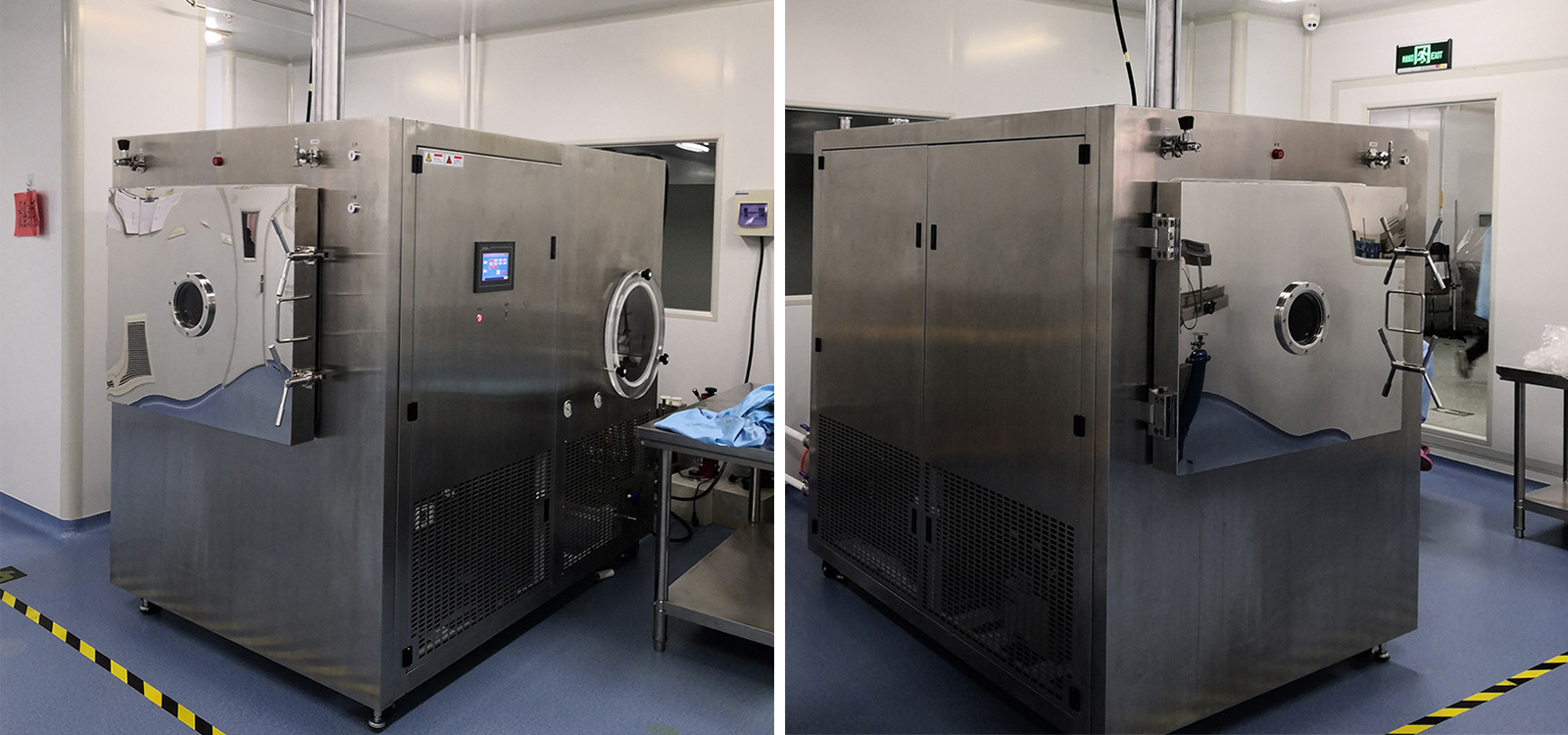
Laboratory workflows require specific dimensional planning. Evaluators looking at an R&D Freeze Dryer for pharmaceutical, biotech, or standardized testing face unique constraints. Vials introduce geometric inefficiencies compared to flat trays.
Calculate usable space precisely. You cannot simply divide shelf area by vial base area. Cylinders leave empty gaps when packed together. Use this calculation method: Usable shelf width × usable shelf depth ÷ (Vial outer diameter + 1mm tolerance squared).
You must also account for the "edge effect." Vials on the extreme perimeter dry much faster due to radiant heat from chamber walls. Critical R&D protocols often leave an empty buffer edge. This buffer reduces practical freeze dryer vial capacity by 5% to 10%. Ignoring this buffer guarantees inconsistent moisture levels across your batch.
Measure the exact inner dimensions of your usable shelf space.
Measure your vial's outer diameter using digital calipers.
Add a 1mm tolerance to the outer diameter for handling clearance.
Square the total vial dimension to account for the grid packing footprint.
Divide the shelf area by the squared vial dimension.
Subtract 10% to account for the radiant heat buffer zone.
Horizontal shelf area becomes useless if the shelf pitch is too short. Shelf pitch refers to the vertical distance between stacked shelves. You must accommodate the vial height plus the partially inserted stopper.
Stoppering mechanisms require extra vertical travel space. When the cycle ends, hydraulic or pneumatic rams compress the shelves together. The shelves press the stoppers fully into the vials under a vacuum. Always verify adjustable shelf spacing if you utilize multiple vial sizes across different projects. Fixed-pitch shelves severely limit future protocol development.
Upgrading shelf area heavily impacts facility readiness. Address these environmental constraints early in your procurement process. A larger shelf capacity demands stronger supporting infrastructure.
High-shelf-area units carry exceptional weight. Thick stainless steel chambers, heavy-duty compressors, and thermal fluid pumps add massive bulk. Benchtop or pilot systems need structural support far exceeding standard laboratory limits.
Use load-rated carts or reinforced stainless-steel tables. Standard lab benches often suffer wobble issues during intense compressor cycles. Vibrations disrupt delicate liquid formulations before they freeze completely. Evaluate your floor load limits if you transition to a multi-shelf pilot unit.
Larger shelves demand larger compressors for cooling and heating. The thermodynamic exchange generates substantial heat exhaust. Plan adequate HVAC capacity to handle the increased BTU output.
If the ambient room overheats, freeze dryer performance degrades rapidly. Condensers struggle to maintain ultra-low temperatures in hot environments. Warm ambient air prevents the refrigerant from shedding heat effectively. Proper ventilation clearances around the chassis remain non-negotiable for consistent batch success.
Larger chambers naturally require higher CFM vacuum pumps. Evacuating a massive chamber quickly requires serious volumetric displacement. These industrial pumps demand extra floor footprint.
Plan for oil-mist exhaust routing immediately. Oil-sealed rotary vane pumps emit microscopic oil vapor during the initial pump-down phase. You must route this exhaust into a fume hood or external vent. Additionally, implement noise mitigation strategies. High-capacity pumps generate constant drone noise, disrupting quiet laboratory environments.
Match your current spatial constraints directly with your future growth expectations. Selecting a unit category requires balancing budget against necessary throughput.
Understand the strict limitations of each equipment tier before requesting quotes.
Benchtop Systems (Typically <0.2 sq meters): Best suited for early-stage proof of concept. They have highly constrained vial capacity. They usually lack robust stoppering mechanisms. Use them for basic feasibility studies.
Pilot and R&D Systems (0.2 to 1.0 sq meters): The sweet spot for protocol development and scale-up mapping. They allow statistically significant batch testing. They offer precise shelf temperature control mirroring production units.
Production Systems (>1.0 sq meters): Floor-standing units built strictly for commercial output. They require dedicated cleanrooms, hard-piped utilities, and massive capital investment.
Scale Category | Typical Area (sq m) | Best Application | Primary Limitation |
|---|---|---|---|
Benchtop | 0.05 - 0.2 | Feasibility & Discovery | No scale-up thermal mapping. |
Pilot / R&D | 0.2 - 1.0 | Protocol Development | Requires robust HVAC & heavy carts. |
Production | >1.0 | Commercial Manufacturing | Inflexible setup, high utility demand. |
Audit your lab's exact container dimensions today. Measure tray sizes and vial outer diameters meticulously. Plot a standard "maximum required batch" on paper. Calculate the required square footage using the formulas above. Only request quotes from manufacturers after establishing this mathematical baseline.
Sizing a lyophilization system requires balancing thermodynamics, physical geometry, and available facility space. Base your procurement strictly on mathematical models rather than theoretical equipment limits. Prioritize precise tray and vial measurements before selecting any hardware. Verify utility infrastructure, specifically HVAC cooling capacity and bench weight limits, well ahead of delivery. Finally, approach equipment vendors with hard numbers justifying your required shelf area, ensuring your investment perfectly matches your throughput goals.
A: No. Filling trays deeper creates a thick product matrix resisting vapor flow. This action exponentially increases primary drying times and traps moisture. The restricted sublimation often leads to product melt-back or complete structural collapse, ruining your entire batch.
A: A larger shelf area allows you to process larger batches simultaneously, but it does not accelerate inherent drying time. Sublimation speed depends on product thickness, shelf temperature, and vacuum depth. However, spreading a fixed product volume over a larger area reduces thickness, thereby speeding up the cycle.
A: We recommend deducting 5% to 10% from the theoretical maximum vial count. This deduction accounts for imperfect manual packing, necessary handling clearance, and the critical edge-effect buffer needed to prevent uneven drying near the radiant chamber walls.