
Call Us Today
+86-13161061539
Send us
- All
- Product Name
- Product Keyword
- Product Model
- Product Summary
- Product Description
- Multi Field Search
Views: 0 Author: Site Editor Publish Time: 2026-08-03 Origin: Site


Selecting the right cooling mechanism is often the most overlooked variable in freeze dryer procurement. Yet, it strictly dictates facility HVAC loads and overall equipment lifespan. Making the wrong choice can lead to significant operational bottlenecks. Whether scaling up a pilot plant or outfitting a new lab with an R&D Freeze Dryer, heat rejection directly controls system efficiency. The cooling configuration determines where you can physically place the unit. It also dictates how effectively the machinery operates under continuous load. Facility infrastructure must match the thermal demands of your chosen equipment precisely.
This article provides a strictly technical and operational comparison of available cooling configurations. We evaluate how each option aligns with facility infrastructure and cleanroom compliance requirements. You will learn how to choose the optimal setup for your process. We aim to help you match equipment capabilities to your specific laboratory environment perfectly.
Air-cooled systems offer plug-and-play flexibility but reject significant heat into the surrounding environment, requiring robust lab HVAC systems.
Water-cooled systems operate quietly and efficiently with zero ambient heat rejection, making them ideal for cleanrooms, provided the facility has a reliable chilled water loop.
Freeze drying is an inherently heat-intensive process. You might naturally assume lyophilization requires only cold temperatures. However, creating deep freeze environments generates massive thermal energy. The system must rapidly cool the product shelves. It must also chill the vapor condenser. The machinery pulls thermal energy away from your product samples. You must then expel this gathered energy efficiently. We call this essential process heat rejection.
Effective lyophilization relies entirely on stable thermodynamics. Compressors drive the entire refrigeration cycle. They compress refrigerant gases to achieve ultra-low temperatures. This mechanical compression creates intense friction and heat. The system must shed this heat continuously. If it fails to reject heat, the compressed refrigerant remains hot. This failure prevents the condenser from reaching optimal target temperatures.
Effective heat rejection ensures stable condenser temperatures. Stability remains vital for capturing vapor during the primary drying phase. Good thermal management prevents overwhelming the room's climate control systems. It keeps the equipment operating within safe manufacturer parameters.
Consistent Vapor Trapping: Cold condensers trap sublimated water vapor efficiently.
Vacuum Pump Protection: Proper heat rejection prevents vapor from bypassing the condenser.
Stable Shelf Temperatures: Efficient compressors maintain precise thermal profiles for sensitive samples.
Failure to properly manage heat rejection creates severe operational risks. You face premature compressor failure and sudden aborted cycles. Poor heat management leads to melted product and compromised sample batches. Warm condensers allow moisture to enter the vacuum pump. Moisture destroys vacuum pump oil and corrodes internal components. Suboptimal cooling ultimately ruins sensitive biological materials and delays vital research.
An air cooled freeze dryer utilizes heavy-duty motorized fans. These fans blow ambient room air across large condenser coils. The forced airflow dissipates heat naturally into the surrounding room. It functions similarly to a standard laboratory refrigerator but scales much larger. The equipment relies entirely on the ambient room temperature to cool its internal refrigerants.
These configurations offer distinct benefits for standard laboratory spaces.
Lower infrastructure requirements: They offer true plug-and-play installation. You generally only need standard electrical power to begin operations.
Portability: You can easily relocate these units within a facility. Changing floor plans or moving to new labs will not disrupt your operations.
Lower initial utility dependency: You avoid complex plumbing installations completely. You do not need dedicated cooling towers or external water chillers.
You must carefully consider the environmental impact of these machines.
HVAC Tax: The unit rejects 100% of its thermal load into the room. If lab HVAC cannot handle the BTU output, ambient temperatures rise rapidly. The freeze dryer then loses efficiency and may potentially overheat.
Noise levels: Cooling fans run continuously during the entire lyophilization cycle. Constant humming increases operator fatigue in enclosed or small labs.
Space requirements: Proper airflow demands strict physical clearance. You must maintain manufacturer-specified open space around the entire unit.
Best Practice: Clean the condenser fins monthly using compressed air. Dust buildup acts as an insulator and severely degrades cooling efficiency.
Common Mistake: Pushing the machine tightly into a corner restricts exhaust airflow. The unit will recirculate its own hot exhaust, leading to rapid compressor failure.
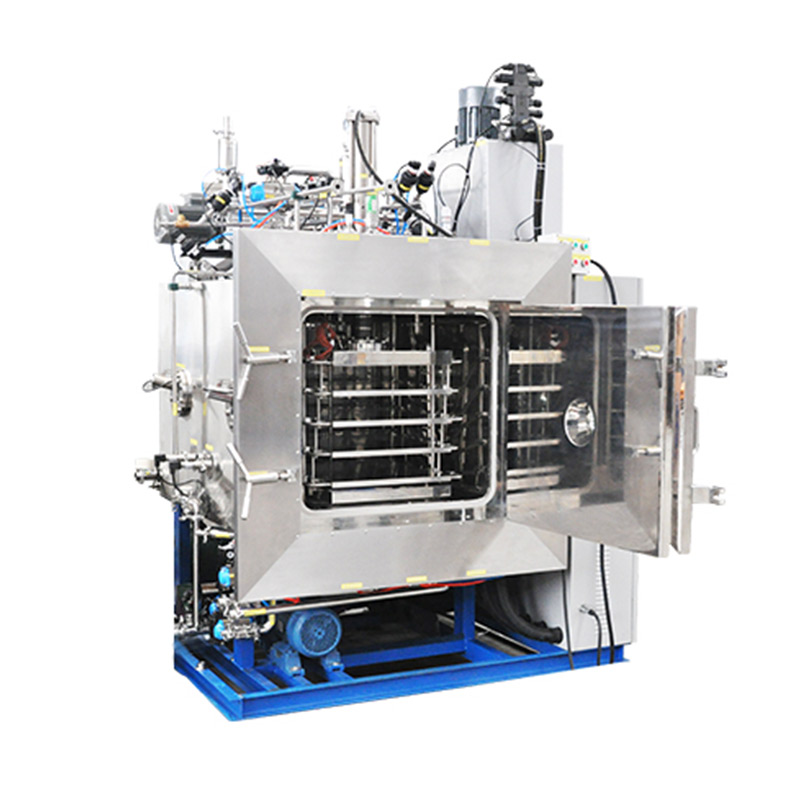
A water cooled freeze dryer uses a continuous flow of liquid. This liquid typically comes from a facility chilled water loop. Internal pumps push the chilled water through a specialized heat exchanger. The water absorbs heat from the refrigeration system. It then carries that thermal energy away from the machine. The heated water returns to the facility chiller for processing.
These systems excel in highly regulated and enclosed environments.
Zero ambient heat rejection: They keep laboratory rooms perfectly neutral. They prove ideal for cleanrooms and GMP facilities. Tightly climate-controlled R&D environments benefit immensely from this stability.
Acoustic comfort: These units operate significantly quieter. They completely lack large, noisy cooling fans.
Higher efficiency at scale: They maintain highly consistent compressor performance. Room temperature fluctuations do not impact their internal cooling output.
Facility readiness remains the biggest hurdle for implementation.
Infrastructure reliance: You need hard plumbing. The system requires a dedicated chilled water supply. Alternatively, you must install a localized recirculating chiller.
Water consumption: Single-pass tap water systems consume massive volumes. Experts strongly recommend against this setup due to severe environmental impact.
Immobility: Once hard-plumbed, they stay in their designated place. Relocating them requires significant facility engineering and pipe fitting.
Best Practice: Install high-quality inline strainers before the water inlet. This prevents facility pipe debris from clogging the sensitive heat exchanger.
Common Mistake: Supplying water warmer than the manufacturer specification reduces condensing capacity. You must verify your facility water loop maintains the correct supply temperature under load.
The following chart summarizes the physical and operational differences between the two configurations.
Evaluation Feature | Air-Cooled Systems | Water-Cooled Systems |
|---|---|---|
Ambient Heat Rejection | High (Requires strong room HVAC) | Zero (Heat removed via liquid) |
Operational Noise Level | Moderate to High (Continuous fans) | Low (Compressor hum only) |
Equipment Portability | High (Usually mounted on casters) | Low (Hard-plumbed to facility) |
Primary Maintenance Focus | Cleaning dust from exterior fins | Monitoring fluid quality and strainers |
You must rigorously assess your laboratory air conditioning capabilities. Compare the engineering effort of upgrading lab AC against the complexity of tapping into facility water. Robust AC easily supports fan-based configurations. Reliable chilled water loops support liquid-cooled models perfectly.
Calculate the exact British Thermal Unit (BTU) output of the equipment. Provide this data to your facility engineer. If the room lacks sufficient airflow turnover, ambient temperatures will spike. Conversely, verify your facility water loop has adequate Gallons Per Minute (GPM) capacity. Insufficient flow rates cause liquid-cooled compressors to stall.
Stringent environments demand strict airborne particle control. Fan-based systems naturally create turbulent air currents. These moving air masses circulate dust and disrupt laminar flow hoods. Such turbulence can easily violate ISO cleanroom standard particle counts. Regulatory auditors often scrutinize equipment exhaust vectors in sterile environments.
Liquid-cooled systems remain preferred for highly regulated environments. They lack external fans entirely. They do not disrupt carefully balanced room pressurization. They introduce zero thermal thermals into the sterile zone. This makes them the standard choice for active pharmaceutical ingredient (API) handling.
Each configuration demands a specific facility maintenance routine. Fan-based models require regular physical cleaning. You must vacuum condenser fins to prevent environmental dust buildup. Neglecting this simple task leads to slow freezing times and overworked compressors.
Liquid-cooled models demand strict fluid quality monitoring. You must prevent mineral scaling inside the internal heat exchanger. Calcium buildup acts as a powerful thermal insulator. It drives up refrigerant head pressures to dangerous levels. You must routinely inspect inline filters and verify biocide levels in your closed-loop chiller lines.
Use the following criteria to narrow down your procurement choices rapidly.
Choose Air-Cooled if: You are outfitting a single unit for a well-ventilated, general-purpose lab. You lack existing chilled water lines. You prioritize upfront installation flexibility. You anticipate moving the equipment to different rooms in the future.
Choose Water-Cooled if: You plan to install multiple units in a single room. You operate in an ISO-classified cleanroom. You already possess a robust facility chilled water loop. You require minimal acoustic interference for your laboratory technicians.
Audit your facility before you request vendor quotes. Contact your site engineering department today. Ask them to verify the total sensible heat removal capacity of your lab HVAC. Request the current available GPM flow rate of your chilled water system. Measure the physical doorways to ensure you can maneuver the equipment into place. Documenting these specific facility limitations prevents costly procurement mistakes.
There is no universal "best" cooling method in lyophilization. The choice is fundamentally a facility management decision. It goes far beyond simple equipment preference. Your local infrastructure dictates the correct path forward.
Align your procurement process directly with your site engineer or facility manager. Map out all ambient environment restrictions early in the project. Finalize your specifications only after verifying facility capacities. By matching the heat rejection method to your building capabilities, you guarantee maximum equipment uptime and reliable product yields.
A: No. It requires manufacturer-specified clearance, usually 18 to 24 inches on all sides. Vents need open space to prevent recirculating exhausted hot air. Proper spacing ensures efficient cooling and prevents the internal compressors from overheating during peak loads.
A: The system will quickly detect a high-pressure fault within the refrigeration cycle. It will automatically shut down to protect the sensitive internal compressors. This built-in safety mechanism prevents severe hardware damage. However, the sudden shutdown will likely result in a lost product batch.
A: Generally, no. The internal refrigeration architecture differs fundamentally between the two types. Compressors, piping logic, and heat exchangers are specific to the chosen cooling method. You must decide on the cooling mechanism at the initial point of purchase.
A: If your building lacks a central chilled water loop, you must purchase a standalone recirculating chiller. This additional equipment supports the internal heat exchanger. It provides the necessary liquid flow but adds to the physical footprint of your installation.