
Call Us Today
+86-13161061539
Send us
- All
- Product Name
- Product Keyword
- Product Model
- Product Summary
- Product Description
- Multi Field Search
Views: 0 Author: Site Editor Publish Time: 2026-08-03 Origin: Site


Transitioning a liquid formulation into a stable lyophilized product is a high-stakes engineering challenge. It is never just a simple laboratory experiment. You face strict physical and thermodynamic limits. Inefficient cycles waste expensive manufacturing time. Overly aggressive cycles risk catastrophic API collapse. Both extremes lead to batch rejection and profit loss. We provide R&D teams and process engineers a pragmatic framework here. You will learn how to design, evaluate, and scale these cycles effectively. We aim to help you avoid costly late-stage redesigns. Properly managing Freeze Drying Cycle Development ensures you balance product quality against commercial viability. This guide covers the critical transition from the lab bench to the production floor.
Establish the Design Space Early: Thermal characterization of the formulation (Tg', Tc) is a non-negotiable prerequisite before testing equipment.
Equipment Parity Matters: Discrepancies between an R&D freeze dryer and commercial units (e.g., heat transfer coefficients) are the #1 cause of scale-up failure.
Optimize for Economics and Quality: A successful cycle balances critical quality attributes (CQAs) with commercially viable processing times.
You often feel the tension between R&D speed and commercial viability. Lab teams want a stable product fast. Manufacturing teams need a short, efficient cycle. A cycle taking an extra 12 hours in the lab might seem trivial. However, it translates to millions in lost manufacturing capacity at scale. You must define your success criteria clearly before starting any physical trials.
Success hinges on two main pillars. You must evaluate both rigorously to ensure commercial viability.
Product Quality: You need an elegant cake appearance. The product must possess low residual moisture. It requires rapid reconstitution capabilities. Most importantly, you must preserve full API efficacy.
Process Economics: You must optimize primary drying time. Energy efficiency plays a major role in scalable success. Your final cycle parameters must guarantee minimal batch rejection.
Relying on empirical trial-and-error is dangerous. "Wing it" engineering relies on guessing parameters. This approach ignores Process Analytical Technology (PAT) and mathematical modeling. Skipping rigorous modeling leads to frequent scale-up failures. You risk wasting expensive active pharmaceutical ingredients. We recommend using robust thermal data to build a solid cycle framework.
Creating a robust process requires mastering three distinct thermodynamic phases. We outline the critical mechanisms and common pitfalls below.
Cooling rates dictate ice crystal size directly. Fast cooling generates many tiny ice crystals. Tiny crystals leave very narrow pores after sublimation. Narrow pores restrict vapor flow during primary drying. This restriction significantly increases your total processing time. Conversely, slow cooling promotes larger ice crystals. Larger crystals create wider pathways for vapor escape.
You can also employ an annealing step. Annealing involves raising the temperature slightly after initial freezing. This step encourages smaller crystals to merge. The resulting larger structure dries much faster. Uncontrolled nucleation remains a major implementation reality in the lab. It causes random freezing patterns across your batch. You cannot rely on these random patterns. They lead to unpredictable primary drying rates in production.
Primary drying removes ice through sublimation. You must balance shelf temperature (Ts) and chamber pressure (Pc). Your main goal is maintaining the product temperature securely. It must remain below its critical collapse temperature (Tc). Pushing the shelf temperature too high causes disaster. The formulation structure will collapse entirely. A collapsed cake ruins the visual appearance. It also severely hampers product reconstitution.
On the other hand, running a cycle too cold wastes time. Extended cycles tie up valuable manufacturing equipment. You must find the optimal thermodynamic sweet spot. This requires continuous monitoring and precise pressure control.
Secondary drying targets the remaining bound water. Ice is gone, but moisture remains trapped inside the matrix. You must remove this moisture to meet strict shelf-life specifications. You achieve this by raising the shelf temperature. You also maintain a deep vacuum environment.
However, you must monitor the heat carefully. Excessive heat easily degrades delicate APIs. Many engineers make a common mistake here. They increase the temperature too aggressively. This aggressive approach compromises product efficacy. A slow, controlled temperature ramp prevents thermal degradation.
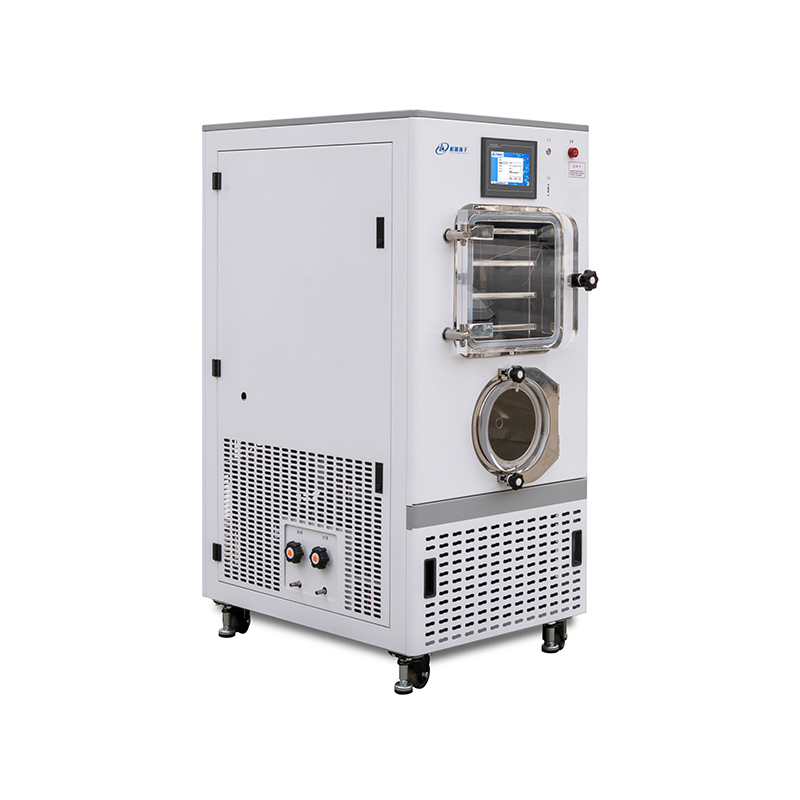
You cannot separate cycle design from the hardware running it. Choosing the right machinery dictates your future success.
A dedicated R&D Freeze Dryer serves as your starting point. It is ideal for initial thermal characterization. You use it for formulation robustness testing and boundary mapping. However, you must acknowledge a critical limitation. Benchtop units often lack the geometry to mimic industrial thermodynamics. Their internal radiation profiles differ drastically from commercial systems. You cannot rely on them for final scale-up data.
You cannot jump straight from the bench to commercial manufacturing. A Pilot Freeze Dryer bridges this critical gap. Pilot units are necessary for generating representative heat and mass transfer data. When evaluating options, look closely at the control systems. The pilot unit must offer the same shelf fluid circulation dynamics as production models. It must mirror the physical constraints of your ultimate commercial machine.
Processing vials under vacuum introduces unique mechanical complexities. You must evaluate a Freeze Dryer with Stoppering capability early. Hydraulic or pneumatic stoppering is mechanically necessary here. It seals vials securely before they re-enter atmospheric pressure. Assess the reliability of this mechanism rigorously. An unreliable system causes unseated stoppers or particulate generation. These issues present severe compliance risks during regulatory audits.
Moving a process to larger hardware introduces complex physics problems. You must address these challenges proactively.
Many engineers assume a 1:1 linear scale-up is possible. We must state transparently this is a physical impossibility. Scaling directly from a lab environment to commercial equipment alters the thermodynamics entirely. Differing wall effects and internal radiation profiles change how heat distributes. Selecting a Freeze Dryer for Process Scale-Up requires rigorous data matching, not simple multiplication.
You must map the heat transfer coefficient (Kv) of your equipment. Compare the lab equipment's Kv against the target commercial unit. You will notice significant discrepancies. Commercial units transfer heat differently due to distinct shelf materials. Instruct your team to use comparative data models. This evidence-oriented approach helps you adjust shelf temperature setpoints accurately. You cannot use the same temperature setpoints across scales. Precise mapping prevents unexpected product collapse.
Sublimation generates massive volumes of water vapor. You must evaluate the vapor port dynamics carefully. High sublimation rates push system limits. The vapor velocity can increase rapidly. Ensure your pilot equipment can stress-test this maximum sublimation rate. It must do so without losing pressure control. If vapor velocity reaches the speed of sound, choked flow occurs. The vapor port cannot handle more volume. This phenomenon causes sudden pressure spikes and product collapse.
Radiant heat complicates the drying process significantly. Chamber walls emit radiant heat continuously. Vials located on the perimeter absorb this extra heat. They dry much faster than vials in the center. We call this phenomenon the edge effect. You must account for this uneven heat distribution during cycle development. Perimeter vials face a higher risk of collapse. Center vials might remain under-dried at cycle completion. Using radiation shields or dummy vials helps mitigate these risks effectively.
R&D managers face tough resource allocation decisions. You must decide how to execute your cycle optimization safely and efficiently.
Choosing your development path requires strategic thinking. You must weigh investing in-house against partnering with a CDMO. Building in-house capabilities requires significant capital and physical space. However, it keeps your proprietary data strictly internal. It gives your team complete scheduling flexibility. Outsourcing to a CDMO saves upfront capital. It also provides immediate access to experienced personnel. Your choice depends heavily on your pipeline volume. High-volume pipelines usually justify in-house investments. Sporadic development projects often fit the CDMO model better.
If you purchase equipment, evaluate vendors rigorously. We recommend using a structured approach. You need a system built for long-term commercial success.
Vendor Assessment Matrix
Evaluation Category | Critical Requirements | Red Flags to Avoid |
|---|---|---|
PAT Integration | Tunable diode laser absorption spectroscopy (TDLAS), wireless temperature probes. | Proprietary sensors that prevent third-party data integration. |
Software Compliance | Full 21 CFR Part 11 compliance for data logging and tech transfer. | Manual data transcription requirements or lack of audit trails. |
Validation Support | Proven vendor track record in post-installation validation (IQ/OQ/PQ) support. | Vendor offers only basic factory acceptance testing (FAT). |
Audit your current formulation thermal data immediately. Do this before issuing any equipment RFP. You cannot buy the right hardware without knowing your formulation's physical limits. Secure reliable Tg' and Tc data first. This preliminary work saves months of frustrating trial and error.
Developing a robust lyophilization process is an exercise in strict risk management. It relies entirely on thermodynamic math, not guesswork. You must respect the physical limits of your formulation. Rushing the process guarantees expensive failures later. Take the time to characterize your thermal parameters properly. Map your equipment carefully to understand internal heat transfer dynamics.
The choices you make in the early R&D and pilot stages matter immensely. They directly dictate the ultimate profitability of your commercialized drug. Small inefficiencies multiply rapidly at scale. Ensure your hardware matches your intended milestones perfectly.
Take action today to secure your manufacturing future. Consult with process engineering specialists to review your current parameters. Alternatively, request a technical demo of scale-up-ready pilot systems. Doing so ensures your next commercial batch runs flawlessly.
A: A standard development process typically spans several weeks to a few months. The exact timeframe depends heavily on formulation complexity and PAT utilization. Simple aqueous solutions might require only a few iterative runs. Highly concentrated biologic formulations demand extensive thermal characterization and boundary limit testing. Using advanced analytical tools can significantly shorten this timeline.
A: Scale-up failures usually stem from thermodynamic differences between machines. Discrepancies in heat transfer coefficients (Kv) are the primary culprit. Commercial units also exhibit different edge effects due to radiant heat from chamber walls. Additionally, larger batches create higher vapor flow resistance, leading to unexpected choked flow and loss of pressure control.
A: No, stoppering is generally not required for bulk tray processing. Stoppering mechanisms are mechanically necessary for vial-based API processing. They ensure vials seal securely under vacuum before the chamber returns to atmospheric pressure. Bulk processing relies on open trays, making hydraulic or pneumatic stoppering systems unnecessary for that specific workflow.
A: A successful transfer requires comprehensive and well-documented data. Critical outputs include accurate product resistance curves and Kv mapping of the source equipment. You also need precise critical temperature limits (Tg' and Tc) for the formulation. Finally, establishing the equipment design space limits ensures the target machine can handle the prescribed sublimation rates.