
Call Us Today
+86-13161061539
Send us
- All
- Product Name
- Product Keyword
- Product Model
- Product Summary
- Product Description
- Multi Field Search
Views: 0 Author: Site Editor Publish Time: 2026-08-17 Origin: Site


Moving from bench-scale formulation to clinical trial manufacturing represents a high-stakes transition for pharmaceutical developers. Product loss or regulatory failure at this critical stage severely derails timelines. You risk compromising highly valuable active pharmaceutical ingredients. We frequently see a major hurdle when developers attempt bridging the gap between standard laboratory lyophilization and fully compliant clinical-scale production. Benchtop units simply cannot deliver the rigorous thermal control required by regulatory bodies. They also lack the necessary software audit trails.
We wrote this guide to provide an objective, evidence-based framework for your equipment selection journey. You will evaluate facility constraints, regulatory compliance, and equipment specifications effectively. This knowledge helps you confidently shortlist the ideal machinery for Phase I and II trials. We explore essential technical features, cleanroom integration, and the stringent validation demands necessary for small-batch pharmaceutical manufacturing.
Transitioning from an R&D environment to clinical production requires prioritizing repeatable tech transfer and strict GMP compliance over basic drying speed.
Essential features for small-batch pharmaceutical production include precise shelf temperature uniformity, integrated stoppering mechanisms, and 21 CFR Part 11-compliant data logging.
True costs extend beyond equipment purchase; facility modifications (cleanroom footprint), utility requirements, and validation processes (IQ/OQ/PQ) dictate final ROI and project timelines.
Many development teams mistakenly attempt to use basic laboratory equipment for early-phase clinical batches. Why is a standard R&D Freeze Dryer insufficient for Phase I and Phase II trials? These rudimentary machines prioritize fast moisture removal over precise environmental control. They lack formal software documentation capabilities. They also suffer from inconsistent thermal mapping across their drying shelves. This temperature variability introduces severe contamination risks and batch inconsistencies.
You must bridge this gap to succeed in pharmaceutical manufacturing. This is where the Pilot Freeze Dryer proves invaluable. Pilot units actively replicate the complex thermodynamic environment of massive commercial production systems. They achieve this performance within a much smaller physical footprint. They utilize the same fluid-filled cooling shelves and proportional vacuum controls found in manufacturing plants.
Formulations must dry successfully and repeatedly. Operators need highly scalable processes. You must document every cycle parameter accurately. Your primary success criteria shift entirely at this stage. You move away from simple moisture sublimation to rigorous process repeatability and verifiable documentation.
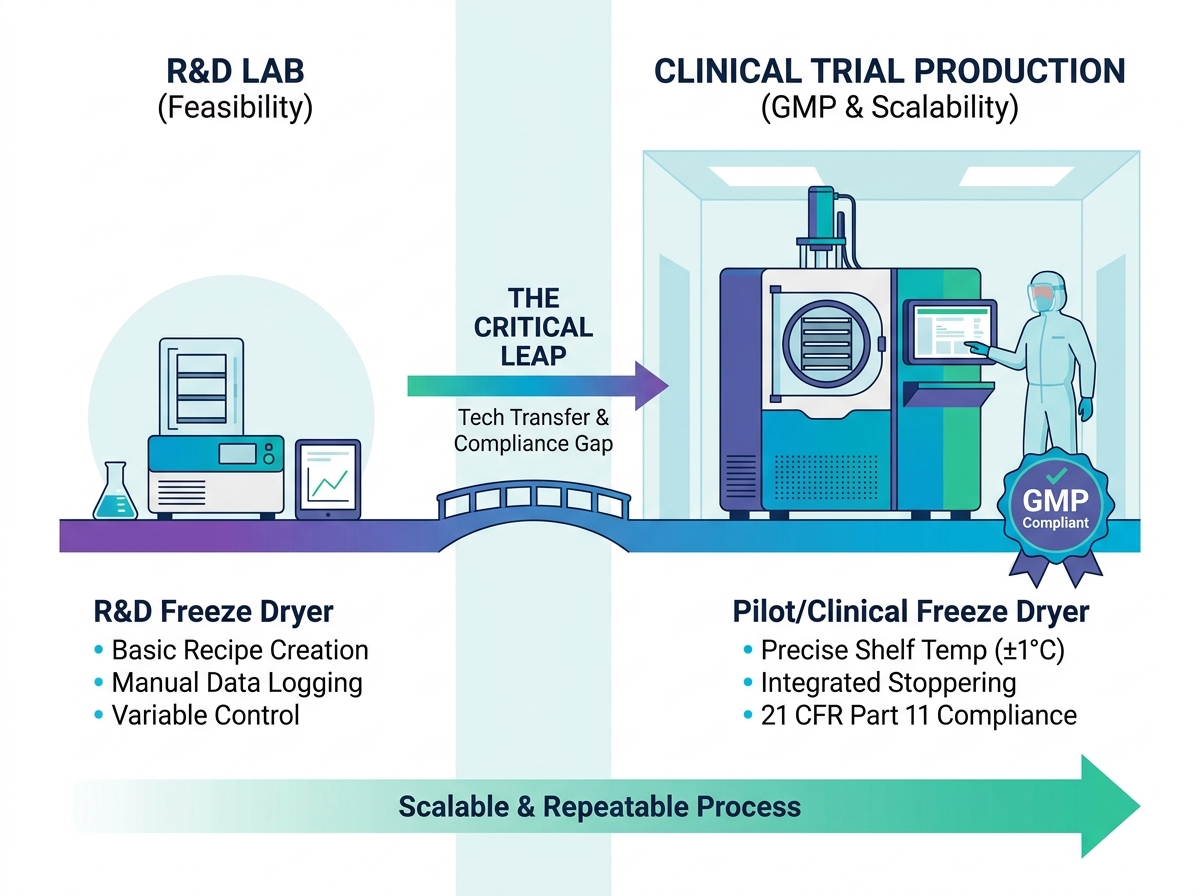
Achieving repeatable tech transfer requires distinct hardware capabilities. You must evaluate internal mechanical specifications closely to protect your product.
Technical Specification | Basic Laboratory Unit | Clinical-Scale Unit |
|---|---|---|
Shelf Temperature Control | Electrical mats (Variable) | Fluid-circulated (Precise) |
Thermal Uniformity | ±3°C or greater | ±1°C or better |
Vacuum Regulation | On/Off Solenoid | Proportional Valve |
Vial Sealing | Manual or absent | Automated hydraulic/pneumatic |
Shelf temperature uniformity dictates product safety directly. A variance exceeding ±1°C across drying shelves jeopardizes high-value active pharmaceutical ingredients (APIs). Uneven heating causes localized melt-back. It leads to collapsed cake structures in specific zones of the chamber. You must specify fluid-circulated shelves engineered for extremely tight thermal tolerances.
Next, analyze condenser capacity against your batch size. Sublimation rates must perfectly match condenser limits. Overloading the internal condenser causes dangerous vapor bypass. Moisture then travels directly into the vacuum system. This ruins the pump and destroys your entire small-batch run.
Vial sealing demands absolute mechanical precision. Utilizing a Stoppering Freeze Dryer is practically mandatory for parenteral drugs. These systems deploy reliable hydraulic or pneumatic mechanisms. They compress grooved rubber stoppers fully into vials under vacuum. Sometimes they seal vials under an inert gas blanket. You isolate the drug product entirely before opening the chamber door.
Finally, evaluate vacuum control dynamics carefully. Primary drying requires precise pressure regulation to control the sublimation interface. Proportional vacuum control utilizing a capacitance manometer provides this accuracy. It adjusts bleed valves dynamically to maintain exact pressure setpoints throughout the cycle.
Regulatory bodies maintain strict expectations for early-phase clinical material generation. You cannot treat regulatory compliance as an afterthought. Both the FDA and EMA demand rigorous proof of process control.
Data integrity stands at the forefront of modern pharmaceutical manufacturing. Software systems must strictly adhere to 21 CFR Part 11 guidelines. This standard mandates unalterable electronic audit trails. It requires unique electronic signatures for every cycle modification. Secure recipe management prevents unauthorized changes to your established drying protocols.
Sterility and cleaning protocols require careful facility evaluation. You must review available sterilization options thoughtfully.
Clean-In-Place (CIP): Automates internal chamber washing using integrated spray balls and validated fluid dynamics.
Sterilize-In-Place (SIP): Utilizes highly pressurized steam to kill all microorganisms inside the chamber.
Manual Cleaning: Relies on operator swabbing and meticulous standard operating procedures.
While SIP remains standard in commercial manufacturing, it increases machine size and complexity drastically. Assess whether manual cleaning protocols work for your facility. If you implement rigorous swabbing and validation, manual cleaning often satisfies Phase 1 trial requirements. However, you still need a verifiable GMP Freeze Dryer designed for comprehensive accessibility and zero dead-legs.
Material certification remains completely non-negotiable. Ensure all product-contact surfaces utilize premium 316L stainless steel. Vendors must provide documented surface finishes, typically noting specific Ra values. Every elastomer and door gasket must carry explicit FDA approval certificates.
Your selected Freeze Dryer for Clinical Trials must act as an accurate predictive model. Successful clinical results mean nothing if you cannot scale the process for commercial production.
Integrating Process Analytical Technology (PAT) eliminates empirical guesswork during scale-up. Modern clinical lyophilizers utilize several advanced monitoring tools:
Tunable Diode Laser Absorption Spectroscopy (TDLAS): Continuously monitors vapor mass flow velocity inside the chamber.
Heat Flux Sensors: Measure heat transfer directly at the vial level without intruding into the product.
Comparative Pressure Measurement: Contrasts Pirani gauge readings against Capacitance Manometers to detect the exact end-point of primary drying.
These sophisticated PAT tools generate highly actionable data. They allow engineers to establish a clear line of sight to eventual commercialization. You optimize drying times based on thermodynamic realities rather than simple trial and error.
Software ecosystems play a pivotal role here. Cycle recipes developed on smaller clinical machines must export seamlessly. You want software platforms sharing the identical logic architecture as massive production-scale equipment. Recipe portability reduces scale-up friction drastically and saves months of redevelopment time.
Installing pharmaceutical-grade equipment requires intense logistical planning. You must analyze physical facility dimensions early in the project. Cleanroom footprint analysis goes far beyond measuring the machine's base width.
Evaluate isolation valve clearance carefully. Ensure maintenance technicians can access internal components easily without breaching the sterile envelope. Many facilities utilize bulkhead mounting configurations. This approach integrates the chamber loading door directly into the cleanroom wall. The messy mechanical components, pumps, and compressors remain outside in a lower-grade technical area.
Utility requirements often create hidden implementation bottlenecks. Clinical-grade lyophilizers demand substantial infrastructure. You need reliable chilled water access for condenser cooling loops. They require dry, oil-free compressed air for pneumatic valves. Analyze phase-specific electrical load requirements before finalizing facility designs.
Validation timelines directly dictate your overall project schedules. You must factor in extensive testing phases.
Factory Acceptance Testing (FAT) occurs at the vendor site to verify basic engineering.
Site Acceptance Testing (SAT) happens post-installation to confirm safe utility connection.
IQ/OQ/PQ protocols require rigorous execution to prove the machine operates exactly as intended.
Acknowledge industry-standard lead times proactively. Custom pharmaceutical units often require 6 to 12 months for manufacturing and delivery. This engineering reality impacts your clinical trial schedules profoundly. Plan your procurement cycles well in advance.
Equipment specifications only tell part of the story. You must evaluate the manufacturer behind the machinery rigorously.
Examine aftermarket support thoroughly. Review their guaranteed response times for emergency service calls. Check the availability of critical spare parts in your region. A robust local network of field service engineers prevents catastrophic downtime during critical batch runs.
Assess documentation transparency during the quoting phase. Does the vendor provide comprehensive validation turnover packages? Pre-approved IQ/OQ templates save your quality assurance team hundreds of hours. They streamline the final qualification process significantly.
Prioritize vendors offering direct application lab access. You should test your specific API formulation on their equipment. Running empirical trials before finalizing the purchase order mitigates severe operational risks. It proves the hardware can handle your specific product characteristics seamlessly.
Selecting the right equipment demands a careful balancing act. You must support current clinical trial batch sizes while anticipating future commercialization roadmaps. Strict regulatory demands govern every engineering decision you make.
Begin by conducting a comprehensive facility utility audit. Define your strict cleanroom constraints clearly. Map out your electrical and cooling capacities accurately. Gather this vital facility data before you request formal vendor quotes. This proactive approach ensures seamless installation and accelerates your path to successful clinical manufacturing.
A: R&D units focus on basic feasibility testing and initial recipe creation. They typically lack advanced thermal controls. Pilot units mimic the exact internal geometry, sophisticated control systems, and data logging capabilities of massive production units. You use pilot systems specifically for accurate scale-up validation.
A: Not always. For Phase 1 trials, it depends on your facility's containment strategy and the specific product. While highly recommended, a fully verifiable GMP design featuring easily accessible manual cleaning can satisfy early regulations. However, you must implement and validate rigorous standard operating procedures.
A: Stoppering mechanisms seal vials under vacuum or inert gas before opening the chamber door. This prevents atmospheric contamination and external moisture ingress. It represents a critical regulatory requirement for ensuring the long-term stability and sterility of parenteral drugs and biologics.